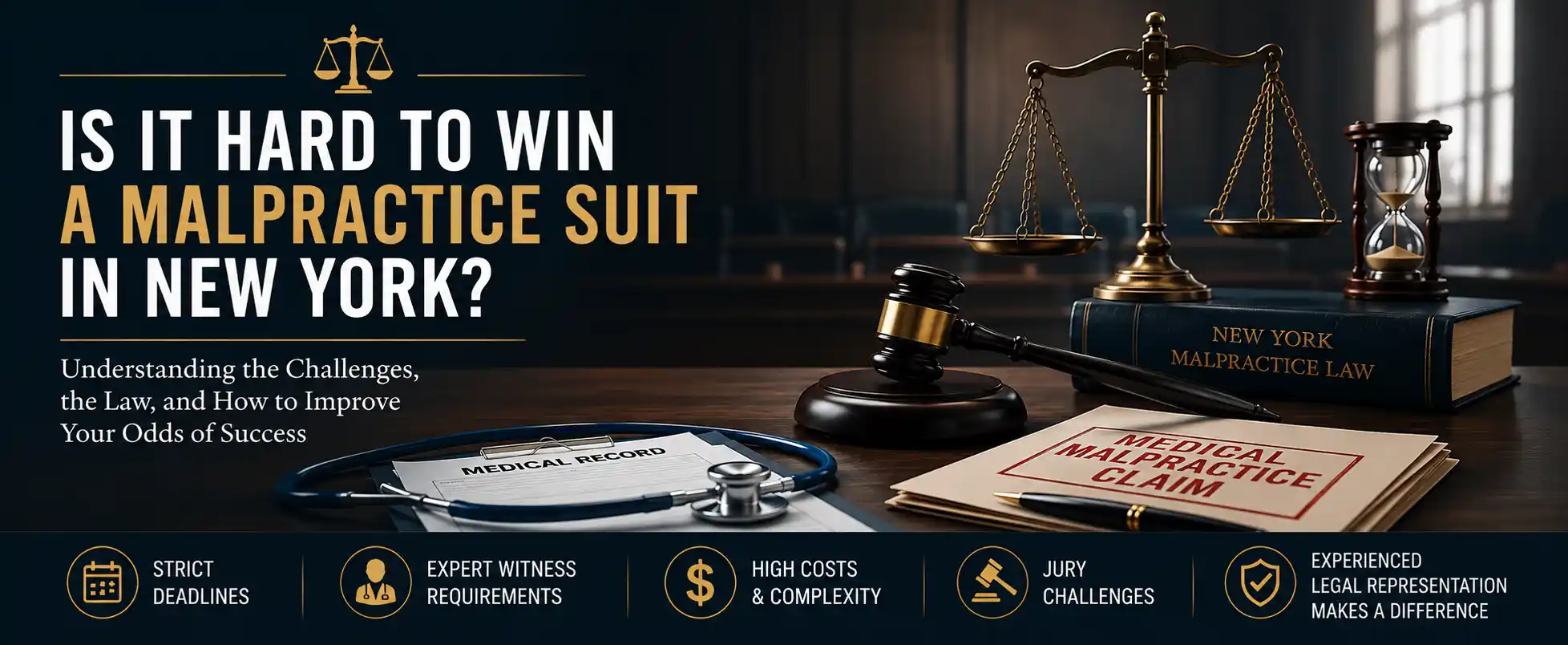

Winning a medical malpractice lawsuit is challenging, including in New York. Between strict procedural deadlines, the high cost of expert witnesses, and juries that may side with doctors, many patients wonder whether pursuing a malpractice case is even realistic. The short answer is that it is hard, but not impossible, especially when strong evidence meets experienced legal representation.
This guide breaks down what makes medical malpractice cases hard to win in New York, what you need to prove, how the law works for and against you, and the concrete steps you can take to improve your odds of winning a medical malpractice claim.
Key Takeaways
- Medical malpractice cases in New York are complex and statistically difficult to win at trial.
- Many medical malpractice cases settle before trial. Over 90% of medical malpractice claims are settled out of court, so “winning” often means negotiating a fair settlement rather than securing a jury verdict.
- Success requires clear proof that a healthcare provider deviated from the accepted standard of care and that this directly caused serious, documented harm. The severity of harm directly impacts the likelihood of a successful lawsuit.
- New York has strict deadlines and procedural rules, so contacting a medical malpractice lawyer quickly is critical.
Why Is It So Hard to Win a Medical Malpractice Case in New York?
Medical malpractice cases are more complex than other personal injury claims because they combine intricate medical issues, strict New York procedural rules, and aggressive defenses funded by hospitals and insurance companies. Medical malpractice cases are extremely expensive to pursue, which limits access for many injured victims.
- Plaintiffs must prove four elements: duty (a doctor-patient relationship existed), deviation from the medical standard of care, causation (the deviation caused the injury), and damages. Failing on any one element will likely lose the malpractice case.
- Jurors often give doctors the benefit of the doubt. Many patients trust medical providers, and juries often empathize with healthcare providers, which affects verdict outcomes. The plaintiff’s attorneys and expert witnesses must work hard to overcome that natural bias.
- Medical malpractice cases require extensive resources, expert medical witnesses, and substantial litigation costs.
- A “bad outcome” or minor error alone is not enough. The malpractice claim must show that no reasonably careful healthcare professional would have acted the same way under the same circumstances.
Complex Legal and Medical Issues in New York Malpractice Claims
Understanding and explaining what went wrong medically is at the heart of every New York malpractice lawsuit. Medical malpractice cases involve dense medical records, technical terminology, and competing interpretations of test results, imaging, and treatment choices.
Jurors often struggle to distinguish between acceptable judgment calls and medical negligence without clear, credible medical experts guiding them. Connecting the doctor’s breach of duty to the specific injury can be complex, especially when the medicine itself is ambiguous.
The plaintiff must show how the healthcare provider deviated from the accepted standard of care, meaning what a reasonably prudent doctor or hospital in the same field would have done under the same standard of practice. New York evidence rules and pretrial motion practice allow defense lawyers to attack expert reports and testimony, making it harder for borderline cases to survive.
You Need a Very Strong Case to Win a New York Medical Malpractice Claim
A high burden of proof exists in medical malpractice suits, which means firms look for clear, objective proof of medical errors before filing a malpractice lawsuit.
- Examples of strong evidence include misread imaging, missed lab results, wrong-site surgery, retained surgical instruments, and ignored red-flag symptoms, such as diagnostic errors that lead to delayed treatment.
- Medical malpractice cases often focus on catastrophic injuries, death, or permanent disability because the severity of harm directly impacts the likelihood of a successful outcome.
- Plaintiffs must document substantial damages: medical bills, long-term care needs, lost wages, and a measurable impact on daily life and future earning capacity.
Medical malpractice attorneys Ronemus & Vilensky evaluates each potential viable medical malpractice case in New York to determine whether the evidence, medical expert support, and damages justify moving forward on a contingency basis.
Differentiating Underlying Illness from Malpractice
One of the toughest issues in New York malpractice claims is separating the harm caused by the original disease from the injury caused by negligent care. Pre-existing conditions can significantly complicate the proof of causation in malpractice cases.
In misdiagnosis or delayed diagnosis cases, such as failure to detect a stroke, sepsis, or cancer, it can be difficult to prove how much worse the outcome would have been because of the delay. Proving causation is a critical challenge in medical malpractice lawsuits, and defense medical experts routinely argue that the patient’s underlying condition, age, or pre-existing problems, not malpractice, caused the outcome.
Successful plaintiffs typically use detailed timelines, expert testimony, and medical literature to show how earlier or proper care would likely have prevented a specific injury. For example, in a failure to order imaging in an emergency room that leads to missed internal bleeding, the plaintiff must demonstrate that prompt diagnosis and treatment would have changed the result.
Key Requirements to Prove a Medical Malpractice Case in New York
Proving medical malpractice requires demonstrating negligence and causation, and the burden of proof rests entirely on the injured patient.
The four elements a plaintiff must establish are:
- Duty: A doctor-patient relationship existed, meaning the doctor agreed to provide care.
- Breach: The healthcare provider deviated from the acceptable standard of care.
- Causation: The deviation directly caused the injury. Plaintiffs must prove a healthcare provider’s negligence directly caused harm.
- Damages: Real, quantifiable harm resulted, including medical expenses, lost wages, and pain and suffering.
New York courts expect plaintiffs to support their malpractice claims with expert affidavits and detailed medical records, not just personal testimony. Plaintiffs must prove that a doctor breached the standard of care through strong evidence, not speculation.
Consider a 2025 New York surgical error case where a retained surgical instrument is discovered after an abdominal procedure. The duty is clear (the surgeon operated). The breach is clear (no reasonably careful surgeon leaves an instrument behind). Causation links the instrument to infection and additional surgery. Damages include hospital bills, extended recovery, and pain. Even in a straightforward scenario like this, expert testimony is still required.
Medical Records as the Foundation of a New York Medical Malpractice Claim
Medical records are the starting point for any malpractice investigation in New York. They show what the healthcare provider knew, what tests were ordered, what was charted, and which symptoms were documented.
- Inconsistencies, missing notes, or late entries can become powerful evidence in medical malpractice lawsuits.
- Request and safely store copies of all hospital charts, office visits, imaging, lab results, and discharge summaries as soon as you suspect malpractice occurred.
- Under New York law, patients generally have the right to obtain copies of their records, though medical providers may charge copying fees.
Ronemus & Vilensky assists New York clients with obtaining and organizing their medical records for expert review.
Expert Witnesses in New York Malpractice Litigation
Expert witnesses convert complex medical facts into clear explanations for judges and juries. New York medical malpractice cases often require multiple experts. For instance, a birth injury claim might need both an obstetrician and a pediatric neurologist.
Expert fees, depositions, and trial testimony are major expenses, which is why law firms reserve them for serious malpractice cases with substantial damages. A strong medical expert can greatly increase settlement value by convincing insurance companies that a jury is likely to find that malpractice occurred and that the harm caused was preventable.
Proof of Injuries and Damages
Even if negligence is clear, you cannot win a New York medical malpractice suit without proving significant damages. Here is what courts and insurers evaluate:
| Damage Category | Examples |
|---|---|
| Economic damages | Past and future medical expenses, rehabilitation, home care, lost wages, loss of earning capacity |
| Non-economic damages | Pain and suffering, loss of enjoyment of life, loss of consortium |
In some states, tort reform can cap non-economic damages in medical malpractice cases. However, New York does not impose a general cap on pain and suffering damages as of 2026, which means catastrophic cases like brain damage, paralysis, or wrongful death can result in large verdicts.
How New York Law Affects Your Chances of Winning a Malpractice Suit
State-specific rules and deadlines play a major role in whether a malpractice lawsuit can even be filed, let alone won.
Statute of Limitations and Time Limits in New York
Missing a deadline can permanently destroy an otherwise valid New York medical malpractice claim. You must act quickly.
- In many New York medical malpractice cases, the basic statute of limitations is 2 years and 6 months from the date of the negligent act, subject to specific exceptions. This is sometimes referred to as a two-year statute plus six months.
- Special rules apply for continuous treatment, foreign objects left in the body (one year from discovery), and minors (tolled but capped at 10 years). Lavern’s Law extends the deadline for cancer misdiagnosis cases to 2.5 years from the date the patient discovers, or should have discovered, the error.
- Claims against certain public or municipal healthcare providers may require a notice of claim within 90 days, making speed essential.
Only a New York malpractice attorney can safely analyze which time limits apply and whether any tolling or exceptions might extend them.
Procedural Hurdles and Insurance Company Defenses
Beyond deadlines, New York malpractice cases face aggressive procedural and factual defenses. Medical malpractice claims require a pre-suit investigation in many states, and New York has its own version through its certificate of merit requirement under CPLR §3012-a.
Common defense strategies include:
- Arguing that no deviation from the standard of care occurred
- Claiming the injury was unavoidable regardless of treatment
- Blaming the patient’s own health or choices for the outcome
How to Improve Your Odds of Winning a Medical Malpractice Suit in New York
While no lawyer can guarantee a win, there are clear steps New Yorkers can take to strengthen their malpractice case from day one. A skilled lawyer can significantly improve your chances of winning by guiding evidence collection, expert selection, and litigation strategy.
Acting quickly, preserving evidence, following medical advice, and consulting qualified counsel all contribute to better outcomes. Even seemingly small actions like keeping a symptom diary may later help expert witnesses and jurors understand the full story.
Contact a New York Medical Malpractice Lawyer as Early as Possible
Early legal advice can preserve your rights and improve the quality of the eventual malpractice claim. A lawyer can advise you not to sign broad releases or speak extensively with hospital negligence risk managers or insurance adjusters before counsel is retained.
Prompt legal action helps secure medical records, identify potential defendants (doctors, hospitals, clinics), and avoid missing New York deadlines. Ronemus & Vilensky offers free consultations for individuals who believe they may have a New York medical malpractice case.
Medical malpractice lawyers often work on a contingency fee basis, and Ronemus & Vilensky handles malpractice cases with no attorney’s fees owed unless a settlement or verdict is obtained for the injured patient.
Document How Medical Malpractice Has Affected Your Life
Thorough documentation transforms a painful experience into clear evidence that a jury or insurer can understand.
- Keep a daily or weekly journal describing pain levels, emotional distress, sleep problems, and missed activities since the malpractice event.
- Track missed work days, changes in job duties, or forced retirement that may affect future earning capacity.
- Save copies of bills, prescriptions, therapy records, and transportation costs for medical appointments.
These details help New York malpractice lawyers and experts calculate realistic economic and non-economic damages in personal injury lawsuits and other personal injury claims arising from medical negligence.
Preserve and Organize Your Medical Records
Organized records save time and allow medical experts to quickly identify errors in treatment. Promptly request complete charts from hospitals, clinics, and specialists involved before and after the suspected malpractice.
Create a simple chronological folder with admissions, discharge summaries, operative reports, imaging disks, lab results, and medication lists.
Follow Medical Advice and Continue Treatment
Failing to follow reasonable medical advice after the alleged malpractice can allow the defense to argue that you worsened your own condition. Attend follow-up visits, therapy sessions, and recommended specialist consultations.
Consistent treatment records help show ongoing pain, limitations, and disability, supporting damage claims. If you lose trust in the original healthcare provider, seek a second opinion from other medical professionals and keep records of that evaluation. Any changes in symptoms should be promptly reported to both treating doctors and your malpractice attorney.
Contact Ronemus & Vilensky, Experts in Handling Medical Malpractice Claims in New York
Patients and families do not need to navigate New York’s complex malpractice system alone. New York medical malpractice cases are resource-intensive, and having an experienced firm is crucial to gathering strong evidence, hiring medical experts, and dealing with insurers who deploy extensive resources to fight personal injury claims.
Serious injuries from hospital negligence, misdiagnosis, birth injuries, surgical mistakes, and other negligent care warrant a full evaluation by a New York medical malpractice lawyer. Ronemus & Vilensky has decades of experience handling accident and malpractice matters in New York, with a track record recognized by publications such as Super Lawyers (2007–2025) and Top Attorneys, Metro New York.